Meet the SensorFu team - Kai Jalonen
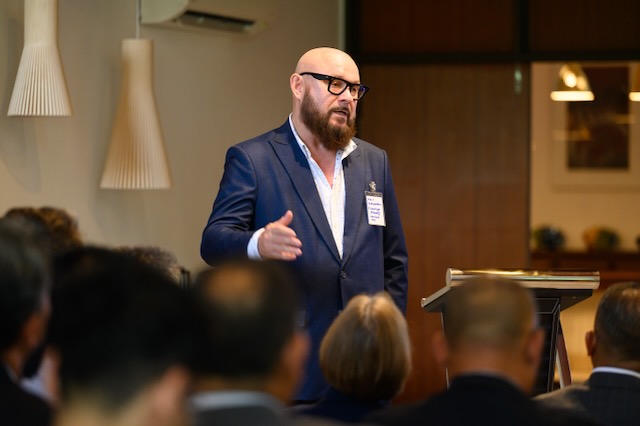
In this week’s Meet the Team, we want to introduce Kai Jalonen. Kai is our Head of Sales and Business Development for the Asia-Pacific Region. With nearly three decades of experience in the technology and cybersecurity industry, he currently leads SensorFu’s Asia-Pacific operations, working closely with partners, customers, and industry stakeholders to strengthen cyber resilience throughout the region.
Kai has played a pivotal role in introducing and growing some of the world’s leading cybersecurity solutions across the region. In this article he shares insights from his career journey, his views on the future of cybersecurity, and the lessons he has learned along the way.
What’s your role at the company, and what does a typical day look like for you?
I am responsible for the Asia-Pacific region for SensorFu. A typical day involves reviewing our active sales pipeline, usually focusing on 6–12 key opportunities and determining the best strategies to move them forward. I work closely with our distributors, resellers, and partners across the region, ensuring strong collaboration and support. I am also frequently involved in planning industry events, conferences, and exhibitions.
A significant part of my role is staying informed about current and emerging cybersecurity regulations throughout the Asia-Pacific market, helping us align our solutions with regional requirements and trends. This includes identifying prospective customers, understanding local market dynamics, and tracking the most important industry events and opportunities within each country and territory.
How did you get started in your career, and what led you to this company?
I have been based in Singapore for the past 29 years, after spending six years working in Finland. I began my career in IT, selling Apple computers, but after several years I wanted to pursue an international career. To broaden my opportunities, I continued my studies with a focus on doing business in Asia.
That decision eventually brought me to Singapore as a postgraduate student. I quickly grew to enjoy both the business environment and the lifestyle here, so I decided to stay. My first role in cybersecurity was with Stonesoft, a Finnish cybersecurity company. I was the first employee in the region and I established operations across Singapore, Japan, Hong Kong, and Australia. Eventually my team grew to 25 professionals. Since then, I have spent more than 25 years working with a wide range of cybersecurity vendors and technologies across the industry.
I first learned about SensorFu while attending the RSA Conference in San Francisco, where I met Mikko Varpiola. He introduced me to how SensorFu’s technology validates whether networks are truly isolated. I immediately found the concept compelling because it addresses a critical security challenge in a straightforward and easy-to-understand way.
How would you describe SensorFu company culture and how does it differ from other places you’ve worked?
I would say the company culture is very much aligned with Finnish values. It is built on a foundation of trust and mutual respect. I trust the owners and senior management, and I feel they trust me to do my job effectively. As a result, there is far less micromanagement than I have experienced in some previous, non-Finnish organizations. What I appreciate most is the open and transparent communication culture. The trust-based approach works both ways.
What motivated you to get involved in cybersecurity?
What attracted me to cybersecurity was the opportunity to help organizations protect themselves from real threats. Whether they are private companies, public institutions, or government agencies, there is something very rewarding about helping the good guys defend themselves against the bad actors. It felt like meaningful work with a clear purpose.
What’s a project or achievement you’re particularly proud of?
I have been really lucky over the past three decades, to have the privilege of introducing a wide range of Western cybersecurity solutions to the Singapore market. Many of these technologies have gone on to play a role in strengthening the security of Singapore’s critical infrastructure and key enterprises.
I see Singapore as my second home country, and I am deeply grateful for the opportunities and experiences it has provided me. I hope that, through my contributions to the cybersecurity industry, I have been able to give back in some small way to this remarkable nation.
What is the one cybersecurity trend or threat that you think more people should be paying attention to right now?
Deepfakes and AI-driven fraud are becoming increasingly sophisticated and accessible. Like any technology, AI can be used for both positive and negative purposes. While it has tremendous potential to improve productivity and innovation, it is also being exploited by criminals to create convincing scams, impersonations, and fraudulent schemes.
As these threats continue to evolve, individuals and organizations need to stay vigilant. Raising awareness, verifying information carefully, and maintaining healthy skepticism are becoming essential skills to avoid becoming victims of AI-powered fraud.
Where do you see the cybersecurity landscape heading by 2030? Are we winning the race against the “bad actors”?
Wow, that’s a tough question. The obvious answer is AI. It’s everywhere, and like most technologies, it can be used by both good and bad actors. Both sides are already taking advantage of AI to achieve their goals, whether that’s improving efficiency and security or developing more sophisticated attacks.
I’ve been in cybersecurity since the early days of the industry. When I worked at Stonesoft, they were building high-performance, fault-tolerant firewalls at a time when e-commerce was just beginning to take off and people were starting to buy airline tickets online and use online banking services.
From those early days to where we are today, cybersecurity has always been a balancing act between defenders and attackers. Every new technology creates opportunities for innovation, but it also introduces new risks. I believe that trend will continue through 2030 and beyond. As new tools emerge, both good and bad actors will find ways to leverage them, and the challenge will be ensuring that security keeps pace with innovation.
What’s your favorite way to “unplug” and recharge after a day of being constantly connected?
Outside of work, I enjoy staying active and spending time outdoors. I play guitar and tennis, and I am also a cyclist. I particularly enjoy winter sports, although Singapore is not exactly the ideal location for them. I also enjoy music, both playing and listening to it.
If you weren’t working in cybersecurity, what would your “dream job” be?
My dream job would have been to become a rock star, not just a star within an industry, but an actual musician performing on stage and touring the world. I started playing in a band when I was 13 years old and loved the experience. However, even at a young age, I realized that pursuing music as a full-time career could be a risky path. At times I am still wondering, should I have taken that anyway :-)
If you could give one piece of advice to someone just starting out in this industry what would it be?
My advice would be to invest time in understanding AI and its growing role in cybersecurity. AI is already transforming many aspects of the industry, and I believe it will increasingly automate tasks such as software development, code analysis, and application security testing.
Rather than viewing AI as a separate field, it is important to understand how it can be applied to strengthen cybersecurity capabilities. Those entering the industry should immerse themselves in AI technologies, learn how they work, and explore how they can be used to improve threat and vulnerability detection, security testing, automation, and overall cyber resilience.
The future of cybersecurity will be closely tied to artificial intelligence, and professionals who understand both disciplines will be well positioned to make a significant impact.


