Network Isolation Verification When Using Attack Path Management

Security operations centres don’t suffer from a lack of visibility. They suffer from alert fatigue. Modern environments maintain multiple dashboards tracking active alerts, asset inventories, configuration changes and unpatched vulnerabilities. Within exposure management, Attack Path Management (APM) tools have emerged to map this data into visual attack graphs.
However, when protecting Operational Technology (OT), Industrial Control Systems (ICS) and critical infrastructure, identifying potential attack paths is different from validating actual network isolation. When it comes to critical OT environments, security teams shouldn’t have to assume their network isolation works based on an attack path model or a firewall rule. They need to be able to prove it. Understanding where Attack Path Management ends and active network isolation verification begins and why critical infrastructure defence requires both—is vital to securing operational environments.
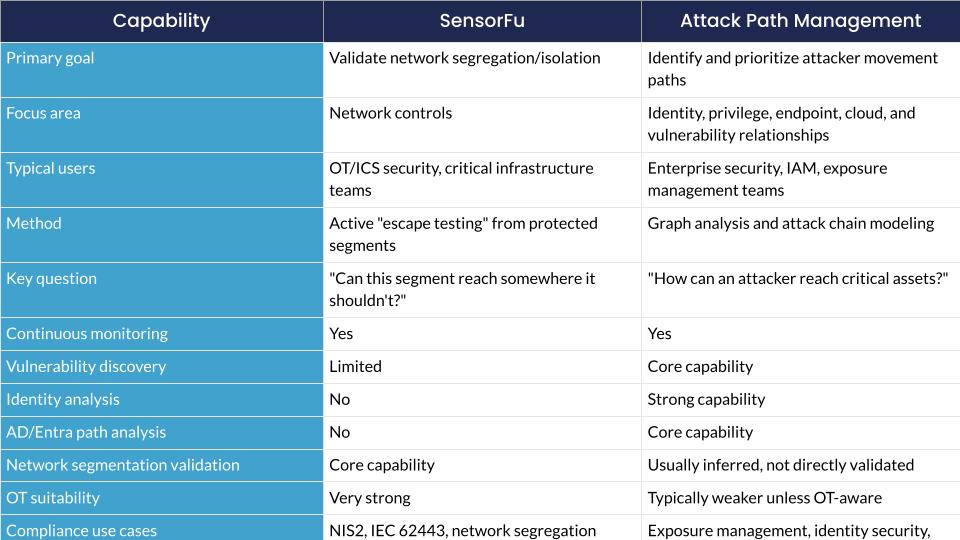
Attack path analysis vs. continuous network segmentation verification for OT, ICS and critical infrastructure
Attack Path Management solutions such as Microsoft Security Exposure Management, SpecterOps BloodHound, XM Cyber and Palo Alto Cortex Exposure Management focus on understanding how attackers could move through identities, endpoints, cloud assets, vulnerabilities, privileges and trust relationships to reach critical assets. They build a broader picture of potential attack paths and help organisations identify where an adversary could escalate privileges or move laterally through the environment.
SensorFu Beacon takes a different, complementary approach. Purpose-built for OT, ICS, critical infrastructure and segmented environments, SensorFu Beacon continuously validates whether the network controls designed to prevent that movement are actually enforcing the intended boundaries.
SensorFu Beacon is placed inside an isolated network segment and continuously tests whether it can reach Beacon Home, which is located outside the isolated segment, either in another network segment or on the Internet. It uses multiple escape methods to test for possible paths across the network boundary.
This provides real-world validation rather than relying solely on firewall, VLAN or routing configurations being correct, and can uncover unexpected network paths caused by routing, VLAN, firewall, VPN or cabling issues.
Together, these approaches provide complementary visibility:
- Attack Path Management helps organisations understand how an attacker could reach a critical asset
- SensorFu Beacon helps prove whether the network isolation and segmentation intended to stop them actually works.
For OT environments where network boundaries are a critical security control, this moves security teams from assuming network isolation is effective to continuously proving it.
Consider a power utility with a security boundary that looks secure on paper, but a firewall rule, maintenance VPN or misconfigured VLAN has created an unintended path between networks. SensorFu Beacon detects that path and shows when network isolation is no longer working as intended.
At the same time, Attack Path Management may identify that a helpdesk account can indirectly become Domain Admin, a vulnerable workstation could expose privileged credentials, or a cloud identity could reach critical assets through chained permissions. In other words, SensorFu Beacon validates the walls, while Attack Path Management maps what could happen if an attacker finds a way through them.
For most organisations, these solutions are complementary to each other. SensorFu Beacon provides continuous validation of network isolation and segmentation, particularly between IT, OT and other critical zones, while solutions such as Microsoft Security Exposure Management and BloodHound focus on identity, privilege, endpoint and cloud-based attack paths.
Together, they provide a more complete view of security: Are the walls intact, and what happens if someone gets inside? For OT-heavy and critical infrastructure environments, SensorFu Beacon fills an important gap by moving organisations from assuming network segmentation is effective to continuously proving that it works in practice.


